






 Spell
 Quick
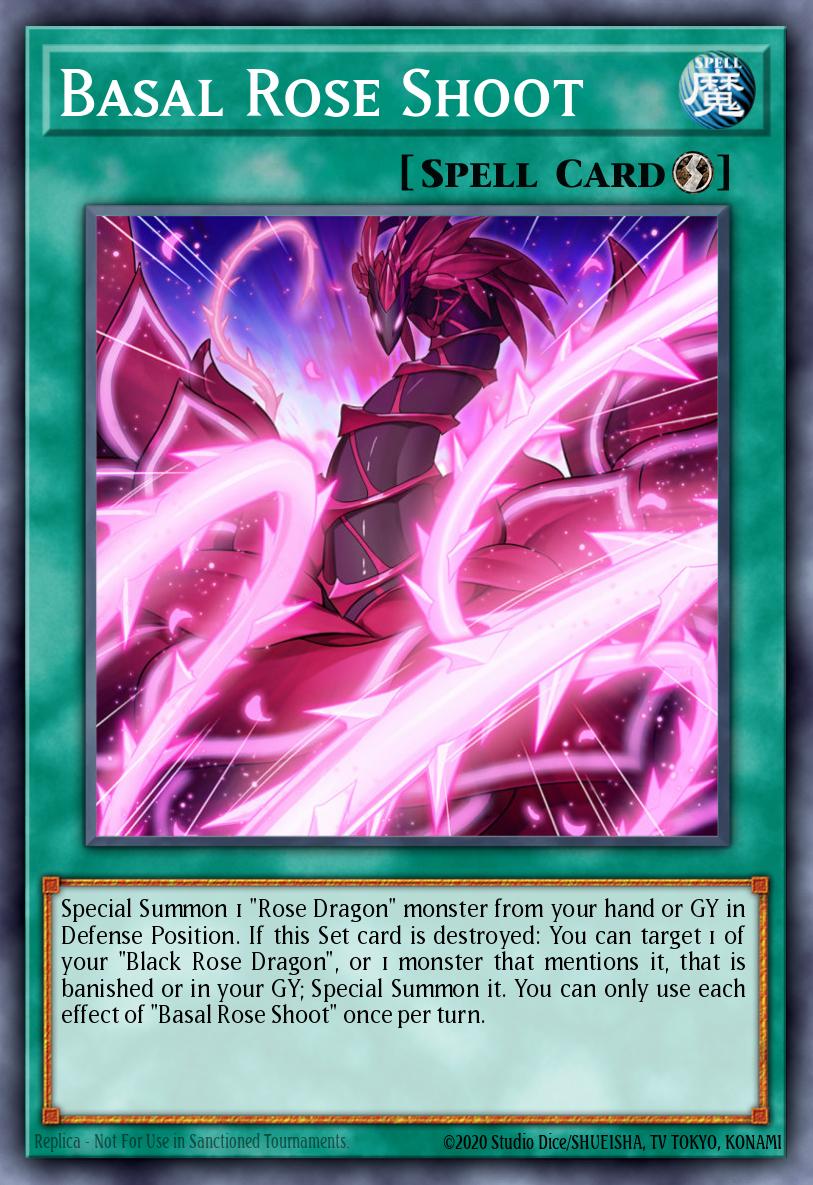
Basal Rose Shoot
Archetype:
Rose
View:
4248
Special Summon 1 "Rose Dragon" monster from your hand or GY in Defense Position. If this Set card is destroyed: You can target 1 of your "Black Rose Dragon", or 1 monster that mentions it, that is banished or in your GY; Special Summon it. You can only use each effect of "Basal Rose Shoot" once per turn.
Basal Rose Shoot — Power Evaluation
Final Score: 51 ± 8 · Confidence: Medium
- Intrinsic: 49 · Deck: 53 · Meta: provisional
- Primary role: Starter / Combo enabler · Secondary: Recovery/Recursion
Why it scores here
Basal Rose Shoot converts a Rose Dragon in hand or GY into a defense-position body, and if it is destroyed while Set it can revive Black Rose Dragon or a monster that mentions it. It is a free, one-copy starter-recursion piece with no interaction, so its score rests on access and recursion, not on the ATK or the Rose Dragon monster it summons. Its appearance in 400 of 400 decks reflects being a staple in one dominant archetype (Rose Dragon, 36.8% of decks), not intrinsic strength, so that frequency is only used to confirm the role is real. No combo boards were supplied, so the conversion score is text-only inference.
Axis scores
| Axis | Score | Evidence |
|---|---|---|
| Accessibility | 60 | Needs a Rose Dragon monster in hand or GY; it runs in 400/400 sampled decks, so access is common but depends on the named monster (observed, inferred from text). |
| Combo & Conversion | 42 | Text gives one defense-position summon plus a revive on destruction, with no ATK or board width; no combo examples were supplied (inferred). |
| Resource Economy | 55 | Spell that summons a monster from hand or GY is roughly card-neutral; the destroyed-while-Set revive adds some recursion value (inferred from text). |
| Effect & Interaction | 10 | No negation, removal or hand-trap effect in the text (verified). |
| Material Utility | 5 | The card itself is a Spell and never becomes material; the summoned Rose Dragon's material value is not part of this card (verified). |
| Resilience & Flexibility | 55 | Its revive triggers when it is destroyed while Set, so the value survives removal; it is limited to once per turn per effect (verified from text, inferred for value). |
| Deck-Building Efficiency | 78 | Average 1.27 copies per deck with 330/400 decks running 1 copy; no garnet or lock cost in the text (observed). |
Calculation
Weight profile: 0.7 Starter/Combo enabler + 0.3 Recovery/Recursion. Intrinsic ≈ 49, Deck ≈ 53, Meta = provisional. Modifiers: none. Final formula: 0.40*Intrinsic + 0.60*Deck
Strengths
- Free Special Summon from hand or GY with no card cost beyond the Spell itself
- Revive trigger on destruction while Set gives recursion that survives removal
- Single copy is usually enough, so deck slot cost is low
Weaknesses
- Requires a Rose Dragon monster in hand or GY, so it is dead without that named body
- No interaction: no negation, removal or hand-trap effect
- Each effect is once per turn, which limits repeated use
Counters / choke points
- Interaction that targets the Rose Dragon monster before this card resolves
- Negation of a Quick-Play Spell activation in the Spell zone
Best use
Starter / recursion Quick-Play Spell. Decks: Rose Dragon. Suggested copies: 1.
Evidence & gaps
- Verified: Set Quick-Play Spell with two once-per-turn effects, text as supplied; Runs in 400 of 400 sampled decks; 330 at 1 copy; Usage statistics: Rose Dragon archetype inclusion 66.7%, typical copies 1
- Observed: Rose Dragon archetype is 36.8% of the sampled decks; Partners Roxrose Dragon, Black Rose Dragon and Red Rose Dragon appear in 92–100% of decks; Five guides mention the card's Rose Dragon line as a core staple
- Inferred: Starter role is real but unconfirmed by combo data; Recursion value from revive-on-destruction; Summoned Rose Dragon's ATK or board output is not credited to this card
- Data gaps: no combos supplied — combo conversion is text-only inference no banlist token — assumed 3 copies (unlimited) no rulings or timing examples for the destroyed-while-Set trigger usage statistics cover only two archetypes, so cross-home inclusion is thin